Horary
How to Judge a Horary Chart, Step by Step
Horary answers a single question from a single chart, cast for the moment the question is understood and asked in earnest. Where a nativity describes a life and a mundane chart reads the age, horary narrows to one thing a person needs settled — whether the ring is still in the house, whether the offer will come — and holds the chart to answering it. What follows is the procedure I work at the desk, in the order I work it, drawn from the tradition it comes from.

What does it mean to judge a horary chart?
To judge a horary chart is to read one chart, cast for the moment a real question is understood, and reach a definite verdict on it. The Ascendant and its ruler stand for the person asking; the house that governs the matter, and its ruler, stand for the thing asked about; and whether those two rulers come to an aspect decides whether the matter comes to pass.
This is the single-chart method William Lilly set down in Christian Astrology (1647), still the fullest handbook the English tradition has produced (Book II, full text). You settle a question here rather than read a character, and the discipline of the art is that it will not let you hedge: the ring is in the house or it is not, the offer comes or it does not. That refusal to equivocate is what makes horary worth practising, and what makes it unforgiving to practise badly.
Is the chart fit to judge?
Before you judge, confirm the chart is radical, meaning fit to be trusted. As a rule the Ascendant should fall between about 3° and 27° of its sign, and the Moon should apply to some further aspect before she leaves hers. An Ascendant in the first three degrees says the matter is not yet ripe for judgment; one in the last three says it is already past deciding, out of the querent’s hands.
These are Lilly’s considerations before judgement, gathered by Deborah Houlding (Skyscript). Two more earn their place at the desk. Saturn in the Ascendant, and worse if retrograde, warns that the matter “seldom or never comes to good”; Saturn in the seventh throws the warning back on the astrologer, corrupting the judgment itself. Read the considerations less as a gate that bars the chart than as the chart’s own account of how, and whether, to proceed.
Who are the significators?
The significators are the planets that stand in for the parties. The querent, the one asking, takes the ruler of the Ascendant, with the Moon as co-significator in every chart without exception. The quesited, the matter itself, takes the ruler of whichever house governs it: the seventh for a partner or an open enemy, the second for money, the tenth for the career, the sixth for a lost animal or an illness.
Assign the house first and read its ruler second. A question about a partner belongs to the seventh, so the planet ruling the sign on the seventh cusp becomes the quesited’s significator, and the whole judgment then turns on what these two planets do to one another. Everything after this step is a matter of watching them move.
What is the Moon doing?
Always read the Moon. Beyond standing in for the querent, she is the chart’s reporter: her last aspect tells you what has just happened, her next tells you what comes, and her condition tints the whole question. Often it is the Moon’s applying aspect, not the significators’, that carries the answer.
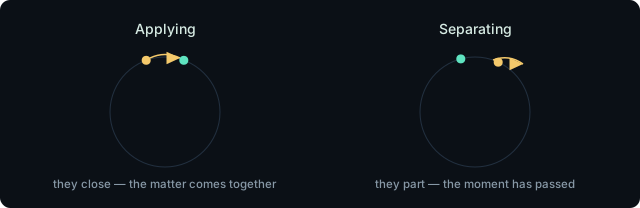
Watch for the void-of-course Moon, the Moon that will complete no further aspect before she changes sign. Lilly’s rule is blunt: with the Moon void “all manner of matters go hardly on,” which at the desk usually means nothing comes of it. Note his exception, though. A void Moon “somewhat performs” when she is in Taurus, Cancer, Sagittarius, or Pisces (Considerations). A void Moon rarely kills a question outright; it drains the momentum from a chart that would otherwise carry.
How does the matter perfect?
Perfection is the moment the significators complete an exact aspect without being spoiled, and it means the matter comes to pass. Lilly names several roads to it, and which road the chart takes tells you not only whether the thing resolves but how: by whose hand, through what intermediary, against what resistance.
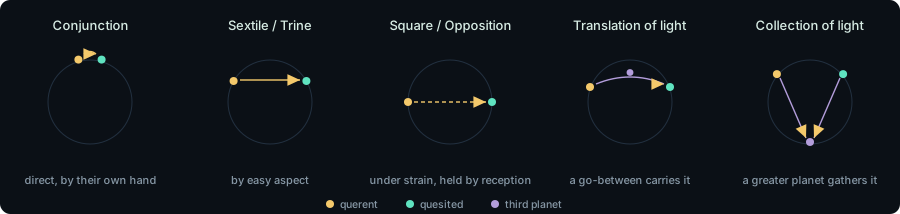
The roads, in the order you should hope for them:
- By conjunction. The two significators close to the same degree, and the parties bring the matter about themselves, directly and by their own motion.
- By sextile or trine. An easy applying aspect; the matter resolves with little friction and little drama.
- By square or opposition. Perfection under strain, which usually holds only when reception supports it, and which tends to exact a cost even where it succeeds.
- By translation of light. A swifter planet separates from one significator and applies to the other, carrying the light between them, so that a third person or a go-between brings the parties together.
- By collection of light. Both significators apply to a slower planet that gathers their light, and someone of greater weight, an authority or an elder or a broker with standing, draws the matter together.
When the two significators hold no aspect at all and neither translation nor collection bridges them, the honest verdict is nearly always that the matter does not come together, however much the querent wishes otherwise.
What can stop it?
An applying aspect can still fail before it perfects. Three classical impediments undo it: prohibition, where a third planet completes its own aspect to a significator first and cuts the connection off; refranation, where a significator turns retrograde and withdraws before the aspect closes; and frustration, where a swifter planet reaches the aspect first and spoils it.
Read each as the chart naming a way the thing goes wrong. A prohibition is the rival bid, the competing claim, the interruption that arrives first. A refranation is the party who loses nerve and pulls back at the threshold. When an aspect that ought to perfect meets an impediment a degree short, the matter comes to the very edge of success and fails there, which is often precisely what the querent reports afterward.
Does reception help or hurt?
Reception is what happens when one significator sits in a sign the other rules, so that the two planets receive one another, and it softens every judgment it touches. A perfection by hard aspect commonly holds only with reception behind it; with mutual reception, even a square can resolve, because the parties are disposed to give way to each other.
Reception is the difference between two people forced together who want nothing from each other and two people at odds who are, underneath the friction, willing. Weigh it against the aspect rather than after it: a frictionless trine with no reception can promise less than a difficult square with strong mutual reception under it.
When will it happen?
Timing comes from the distance left to perfection. Count the degrees between the applying significator, or the Moon, and the exact aspect; the count gives the quantity, and the sign and house give the unit.
Lilly scales that unit by placement: angular houses and cardinal signs pull toward the fast reading of days, succedent houses and fixed signs toward the slow reading of months or even years, cadent houses and common signs toward the middle reading of weeks. Timing is the least certain thing horary does, and the old authors disagree about it openly, so give the querent a range and, more useful than any number, the sequence of events the chart lays out.
The procedure on one question
Illustrative — the steps run on a single chart. A querent asks whether she will be offered a job she interviewed for. The Ascendant falls at 14° Gemini, so Mercury signifies her; the tenth house of the position is ruled by Jupiter, its significator. The chart is radical, the Ascendant mid-sign and the Moon still applying.
Mercury applies to a trine of Jupiter within four degrees, with no planet stepping between them to prohibit it, while the Moon in Taurus applies to a sextile of that same Jupiter, a second testimony agreeing with the first. The judgment reads yes, and without much struggle: an applying trine, unobstructed, seconded by the Moon. For timing, four degrees on an angular ruler in a common sign reads as roughly four weeks, and the corroborating Moon says a second party, a recruiter or a reference, helps carry it through.
Note for Lena. Swap this illustrative case for a real chart from your
/horary/log, with the outcome as it actually fell. A worked example with a verified result is the strongest single signal on the page, and the one thing no competitor can copy.
Judge it yourself
Horary yields to practice sooner than to reading. Cast your own question in the Lunar Punk horary tool, which sets the significators, flags the considerations before judgement, and traces the Moon’s aspects as you go, then record what actually happens in the practice log and watch your hit-rate settle into something you can trust. The chart will answer a plain question plainly; the work is learning to ask one.
Sources
- William Lilly, Christian Astrology (1647), Book II — https://www.astrologiahumana.com/WilliamLilly-ChristianAstrology-BookII.pdf
- Deborah Houlding, “Lilly’s Considerations before Judgement” (compilation) — https://www.skyscript.co.uk/considerations.pdf
- Void-of-course Moon rule and its exception signs (Taurus, Cancer, Sagittarius, Pisces): Lilly, via Houlding (above).