Practical Moon
The Void-of-Course Moon: What It Means, and How to Read It
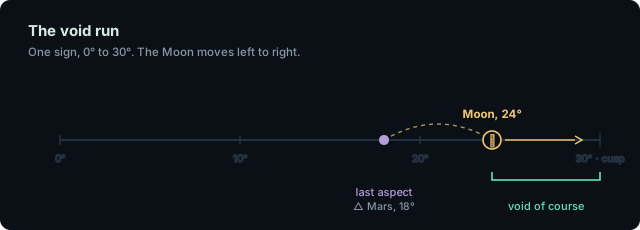
A querent writes at 9:40 on a Tuesday to ask whether the buyer will close. Before I look at significators, before I count houses, I look at the Moon: where she stands, and whether she has anywhere left to go. She sits at 24° Scorpio, her last aspect already behind her, six degrees of empty sign in front of her. She is void of course, and the tradition has a plain thing to say about a Moon in that condition.
What is a void-of-course Moon?
A planet is void of course when it has separated from its last aspect and will complete no other before it leaves the sign it occupies. It happens most often, and weighs most, with the Moon, because she moves fastest and touches everything. William Lilly sets the definition down flatly.
A Planet is void of course, when he is separated from a Planet, nor doth forthwith, during his being in that Sign, apply to any other.
Read it against the sky and it is simple. The Moon has made her last exact aspect inside the sign she is in, and she will reach the next cusp having touched nothing more. “This is most usually in the Moon,” Lilly adds; “in judgments do you carefully observe whether she be void of course” (Christian Astrology, Book II).
How do you tell if the Moon is void of course?
Find the Moon’s last exact aspect to a planet, then look ahead to the degree where she leaves her sign. If she perfects no aspect in the arc that remains, she is void. The whole check takes a moment in an almanac that lists her next aspect alongside her next sign change.
You are asking two questions of the ephemeris: what is the Moon’s next aspect, and does it fall before or after she changes sign. If her next aspect lands in the following sign, then here, now, she is carrying nothing. The Lunar Punk almanac runs the Moon’s position, her next aspect, and her next ingress off Swiss Ephemeris, so you can read the answer instead of counting it by hand.
What does a void-of-course Moon mean in a horary chart?
In horary the void Moon is one of Lilly’s considerations before judgment, a caution posted at the door of the chart. The plain reading is that the matter will go nowhere: with no aspect to perfect, the Moon brings no thing to pass. Lilly writes that “you shall seldom see a business go handsomely forward when she is so.”
It is a warning, not an automatic denial. Strong significators can still carry a question over a void Moon, and I have judged charts where they did. What the void tells you is the drift of the whole thing, the way the current sets under everything else: toward the matter dissolving, the call not coming, the deal quietly failing to happen. Weigh it before you read the horary chart, and let it temper the verdict rather than replace it.
When does the void Moon still act?
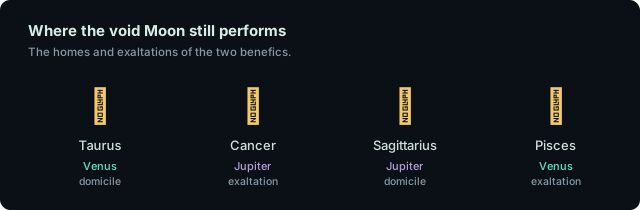
Lilly grants one exception. The void Moon still performs somewhat in Taurus, Cancer, Sagittarius or Pisces, because those four signs are the domiciles and exaltations of the two benefics, and the Moon borrows their goodwill even with nowhere of her own left to go.
All manner of matters go hardly on (except the principal significators be very strong) when the Moon is void of course, yet somewhat she performs if void of course and be either in Taurus, Cancer, Sagittarius or Pisces.
Taurus is the house of Venus and Pisces her exaltation; Sagittarius is the house of Jupiter and Cancer his exaltation. A Moon stranded in one of them stands on benefic ground, and the tradition reads that ground as enough to let a little of the matter through.
Why do modern and traditional astrologers disagree about it?
Modern software usually calls the Moon void from her last exact aspect until she changes sign, counting only perfect aspects between the luminaries and planets. Older practice reckons by the Moon’s actual reach, within her orb, to the bodies she will meet before the cusp. The two rules disagree often, and they disagree about real charts.
The distinction is worth holding because it changes the answer. Anthony Louis lays out how the received modern definition drifted from the traditional one in “The Modern Misunderstanding of the ‘Void of Course’ Moon”. The practical rule is to know which definition your almanac is using before you trust its verdict, because a Moon the software prints as void may still be applying by the older reckoning.
How do you use it in an election?
In electional work you avoid beginning anything you want to prosper while the Moon is void. The logic is horary read forward: start a matter with the Moon empty of aspects and it tends to come to nothing, so you wait for her to apply to a planet that suits the work before you begin.
Watch her the way you would watch the tide. The almanac shows when she goes void and when she next applies, which is usually a short wait, an hour or a morning, rather than a lost day.
The buyer, in the chart I opened with, did not close. The Moon in Scorpio reached 30° touching nothing, and the sale did the same.